
Broderie Anglaise Dresses Australia: The Summer Edit
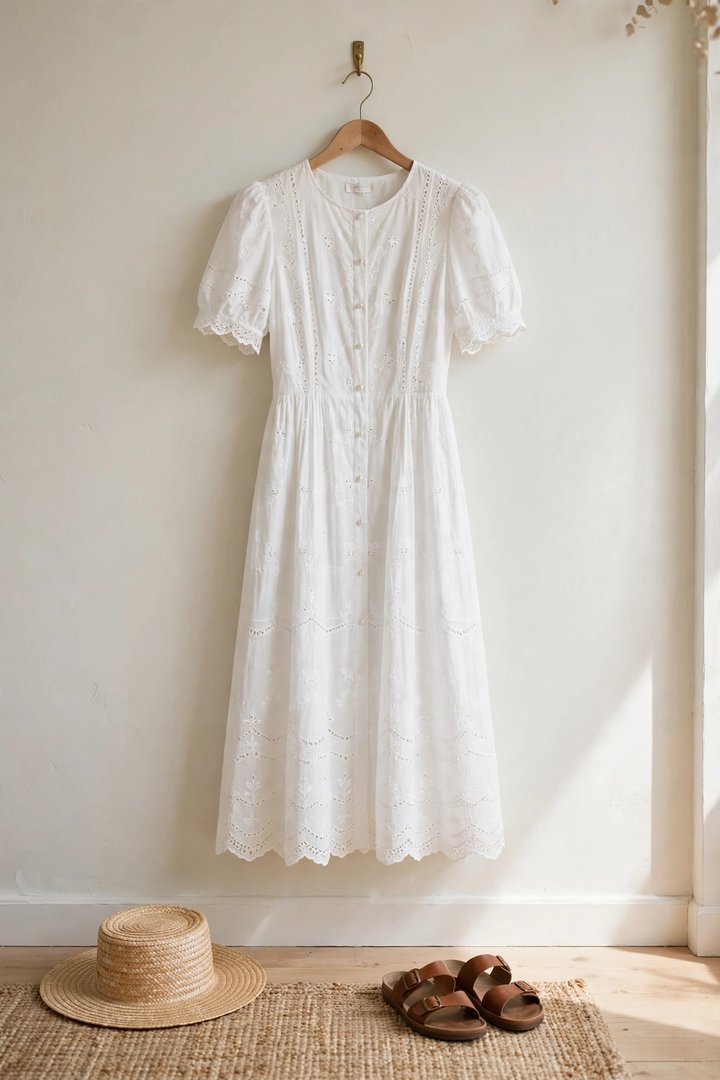
There is a dress that shows up every Australian summer and never really leaves: white or cream cotton, patterned with small cut-out eyelets, cool to the touch. Broderie anglaise dresses Australia shoppers reach for year after year are not a passing trend. The fabric — broderie anglaise, literally “English embroidery” — has dressed women for warm weather for over a century, and it suits this country: it breathes, photographs beautifully in hard sunlight, and looks as right at a beachside lunch as at a garden wedding.
This is the dedicated edit: the fabric, the cuts that work, the labels that do it best, and the checks that separate a dress you will wear for five summers from one that goes sheer after two washes.
What Broderie Anglaise Actually Is
Broderie anglaise is a whitework embroidery technique: small holes are cut into cotton fabric and finished with embroidered edges, usually floral or scalloped. The result is part textile, part lace — solid enough to hold a shape, open enough to let air through. Traditional broderie anglaise is worked on cotton, which is why it feels so good in heat: cotton absorbs moisture, dries fast and does not cling like synthetics.
Shops use the term loosely. Real broderie anglaise has cut work — actual holes, edged with stitching — not printed eyelet patterns or raw laser-cut holes. Cut-and-embroidered eyelets hold their shape through washing; cheap punched holes fray, and printed “eyelet” is flat fabric with none of the airflow. You will also see broderie trims, like a scalloped eyelet hem on a linen dress, which give the look with less sheerness to manage.
Why It Works in Australian Heat
The honest answer is airflow. A broderie anglaise dress is ventilated by design: every eyelet is a small opening, and a full skirt moves air with every step. On a 35-degree day, that matters more than any moisture-wicking claim on a swing tag. Cotton broderie absorbs sweat rather than trapping it, and the usual light colours — white, ivory, ecru, soft blue — reflect heat instead of absorbing it.
It also fits how Australian women dress in summer: pieces that move between settings without a costume change. A broderie midi goes from a school run to a long lunch to an evening drink with a change of shoes. For the broader picture — humidity in the north, cool changes in the south, UV everywhere — our Australian summer fashion guide covers fabrics and seasonal planning. One warning: the holes let UV through, so an eyelet dress is not sun-protective clothing. Wear sunscreen underneath and a hat outdoors.
Broderie Anglaise Dresses Australia: The Cuts That Work
Broderie anglaise has body and structure — it holds a shape rather than draping like silk — so the best cuts let the fabric stand away from the body, move, and show off the pattern. Four cuts cover almost every need.
The Midi Dress
The midi is the safest first buy and the hardest-working cut in the fabric. Between knee and ankle, it is long enough for a lunch or a wedding, short enough to stay cool, and shows off the scalloped hem — often the prettiest part. Look for a defined waist — smocked, belted or seamed — because unshaped broderie can read boxy.
The Maxi Dress
The maxi is the wedding guest and holiday pick. Full-length broderie has a drama shorter cuts cannot match, and the fabric’s stiffness holds a column or A-line shape. Check weight and lining first — unlined broderie can be heavy and see-through in sunlight, so a slip or lined bodice matters more at this length. A V-neck or square neckline keeps it from feeling like a nightdress.
The Shirt Dress
The shirt dress is the most practical cut and the easiest to wear more than one way. A button-front broderie shirt dress works open over swimwear, belted with sandals for lunch, and closed with heeled mules for evening. The collar and placket give it structure, which suits broderie’s crisp hand. Check the buttons sit flat and the placket does not gape — broderie does not stretch, so a shirt dress that pulls at the bust will always pull.
The Tiered Dress
Tiered broderie — gathered tiers falling from a fitted yoke — is the most relaxed and forgiving cut: the gathers show off the eyelet pattern in folds and nothing clings. This is the cut for comfort above all else — beach holidays, long lunches, days on grass — so keep the neckline simple and accessories light.
The Labels to Know
Australia does broderie unusually well — so many local labels design for this climate. These are the names where it appears season after season; check each label’s own site for current pricing.
Zimmermann
Zimmermann is the designer benchmark for broderie anglaise in Australia. The Sydney label returns to the fabric constantly: the Acacia broderie mini in mid-weight eyelet, the Laurel broderie anglaise voile midi with lace trims, and the Mahon broderie anglaise denim midi. It is the most refined broderie you will find — fine cotton, precise cut work, proper slips — priced at the designer end.
Faithfull the Brand
Faithfull the Brand, the Byron Bay label, does broderie in its breezy, holiday register: the Ettore tie-back mini, the Lovis Birgitta mini, and the Lia strapless ruched maxi. The cuts are simple — tie backs, smocked bodices, easy maxis — in cotton that stays wearable in heat, in the contemporary mid-range, well below Zimmermann.
Dissh
Brisbane-born Dissh is the accessible end of this list and the label most Australian women will actually buy from first. Dissh does broderie minis and midis in cotton — short-sleeve button-front styles and off-shoulder cuts — at prices that make a summer dress an easy decision. Dissh designs for Queensland heat. Check the lining before buying: some styles are lined, some rely on a slip.
Tigerlily
Sydney label Tigerlily has built its broderie offering around one family, the Elati range: a tiered mini in cotton broderie with embroidered lace trims and a scalloped hem, a picnic-style maxi, and a matching playsuit with a soft voile lining. The Elati pieces are 100% cotton broderie, exactly what you want in this fabric. Tigerlily sits in the mid-range, and its Australian boutiques let you try the fit before committing. The Elati tiered mini dress is a good example of the style.
Auguste the Label and Kivari
Two more Byron Bay names round out the list. Auguste the Label does broderie in its bohemian register — the Coral tiered midi is a good example — with relaxed shapes and soft colour. Kivari, also Byron-based, does broderie minis like the Daisy, a white long-sleeve yoke mini. Both sit in the contemporary mid-range, stocked widely in Australia.
Styling by Occasion
The dress does most of the work — the pattern is the decoration — so keep everything else simple.
Everyday and Daytime
For day, flat leather sandals or white sneakers, a straw tote or canvas bag, and minimal jewellery: small gold hoops, a fine chain, nothing that competes with the embroidery. A denim jacket handles air-conditioning and cool changes; a linen shirt worn open over a broderie mini turns the dress into a skirt for a beach day. Sunglasses always work.
Wedding Guest
Broderie anglaise is one of the best wedding guest choices for an Australian summer wedding, with two conditions: avoid white — the bride will almost certainly wear it — and choose a colour or a coloured trim. Ivory and cream are also risky; soft blue, sage, butter yellow or a white dress with coloured embroidery are safer. A broderie midi or maxi with block heels (never stilettos on lawn), a small clutch and a wrap for the evening is the formula. Our Australian wedding guest outfits guide covers what each dress code means and the rules that matter.
Evening
For evening, the dress stays the same and everything around it sharpens: heeled mules or a low block heel, a structured clutch, a bolder earring, a slicked-back bun or low ponytail. A black broderie dress — Zimmermann and Tigerlily both do dark versions — is the evening move, because the eyelet pattern reads as texture rather than sweetness in a dark colour. Skip straw and canvas after dark; leather and a little shine are the evening textures.
What to Check Before You Buy
Broderie is easy to buy badly: the problems show up in sunlight, after washing, or halfway through a long day. Run through these checks before you commit.
Lining and Opacity
This is the single most important check. Hold the dress up to a light and look through it: if you can see your hand clearly through the bodice, so can everyone else. A good broderie dress has a lining, a built-in slip, or a double layer in the bodice at minimum; the skirt can be unlined if the fabric is dense, but the bodice should never be sheer. If a dress you love is unlined, budget for a matching slip and try the dress on with it first. Some linings are polyester, which defeats the cotton outer’s breathability — a cotton or cotton-blend lining is worth seeking out.
Cotton Versus Blends
Read the composition label, not the swing tag. The best broderie dresses are 100% cotton, which breathes, softens with wear and handles heat. Cotton blends with a little polyester or viscose are common and not automatically bad — a little synthetic can reduce wrinkling — but a dress that is mostly polyester will not breathe, will hold odour, and will feel clammy in humidity. The giveaway is the hand feel: cotton broderie feels cool and slightly crisp; polyester broderie feels slick and warm. Linen broderie and cotton-linen blends exist too, and our best linen clothing brands in Australia guide covers what to look for in linen.
Fit and Construction
Broderie does not stretch, so fit matters more here than in a jersey dress. Check the seams: eyelet patterns should line up at the side seams, and scalloped hems should sit evenly. A button-front dress that gapes at the bust will always gape — the fabric has no give. Check the armholes on sleeveless styles, which can dig, and try sitting down in it: a dress that looks perfect standing can ride or reveal more when you sit.
Care and Longevity
Cotton broderie is easy to care for: cold or cool machine wash on a gentle cycle, inside a laundry bag if you have one, and line-dry in the shade. Hot water and tumble dryers are the enemies — heat shrinks cotton and distorts the eyelet holes. Iron on medium while slightly damp, or steam it. Treat stains promptly — white cotton shows everything and sunscreen stains set fast in heat, so use dish soap on the mark before washing. Stored clean and dry, a good cotton broderie dress lasts years.
Broderie Anglaise Dresses Australia: Where to Shop
Start with the labels’ own websites — all six sell direct, with full size ranges and the complete current collection. For comparing across brands in one order, THE ICONIC stocks Dissh, Tigerlily, Auguste and Faithfull, and David Jones and Myer carry edited ranges of Australian broderie each summer.
Resale is unusually good for this fabric — designer broderie holds its value, and cotton broderie ages gracefully — so ask for the composition label and a light test before buying pre-loved. Shop in spring, when choice is widest.
FAQs
What is broderie anglaise?
Broderie anglaise is a whitework embroidery technique: small holes cut into cotton fabric and finished with embroidered edges, usually floral or scalloped. The result is a breathable, textured fabric, part textile and part lace, most often seen in white or cream summer dresses.
Are broderie anglaise dresses see-through?
They can be, which is why lining matters. A good broderie dress has a lining, a built-in slip or a double layer in the bodice. Before buying, hold it up to a light: if you can see your hand clearly through the bodice, it needs a slip. The bodice should never be sheer.
What is the best broderie anglaise dress for a wedding guest in Australia?
A midi or maxi in a colour other than white, ivory or cream — soft blue, sage or butter yellow are safe choices — with block heels for grass venues and a wrap for the evening. Avoid white entirely — the bride will almost certainly wear it — and check the dress code before choosing a mini.
Is broderie anglaise cotton or polyester?
Traditional broderie anglaise is cotton, and the best dresses still are. Blends with a little polyester or viscose are acceptable, but a dress that is mostly polyester will not breathe in Australian heat. Read the composition label: 100% cotton is the safest choice.
How do you wash a broderie anglaise dress?
Machine wash cold or cool on a gentle cycle, ideally inside a laundry bag, and line-dry in the shade. Avoid hot water and tumble dryers, which shrink cotton and distort the eyelet holes. Iron on medium while slightly damp, or steam; treat sunscreen stains with dish soap before washing.