
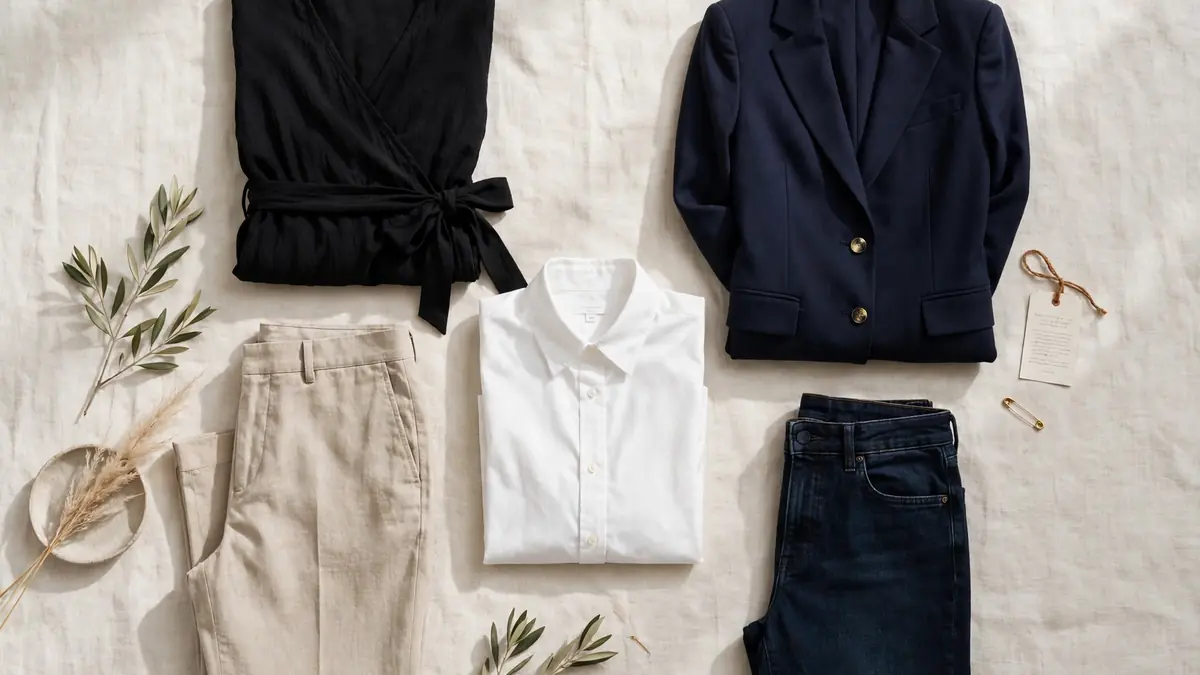
Plus Size Capsule Wardrobe: 10 Pieces That Fit
A plus size capsule wardrobe is not a straight-size capsule bought two sizes bigger. It is a small set of pieces designed — from the first pattern, not the last grading — for a body with curves: a waist genuinely smaller than the hips, a bust that needs shaping rather than extra fabric, and arms and thighs that need room without the whole garment swimming. Get that right and ten pieces carry you through work, weekends, dinners and travel; get it wrong and even a full wardrobe feels like nothing fits.
This guide builds the capsule piece by piece for sizes 14 and up: ten specific pieces, why each needs a curve cut, the outfit formulas they make, and the fit details that decide whether a piece earns its place. It is not a brand roundup — for the full survey of Australian curve labels, see our guide to plus-size fashion brands in Australia.
Why Most Plus Size Capsule Wardrobes Fail Curvy Bodies
Most capsule advice assumes a straight body: the pieces it pictures were patterned for a size 8 or 10 and graded up. Grading scales a pattern bigger; it does not re-proportion it. The result is familiar to anyone who has shopped above a size 14: a shirt that fits the bust and gaps at the buttons, trousers that fit the hips and gape at the waist, and sleeves that pinch at the upper arm.
A curve block fixes this at the pattern stage. The waist-to-hip ratio is built in, darts sit where a fuller bust needs them, the rise is shaped for a rounded hip, and the armhole is cut deeper and wider. Labels that design from a curve block produce clothes that sit properly without constant adjusting. Wikipedia’s overview of plus-size clothing explains how sizing and grading developed, and why the two approaches fit so differently.
The 10 Pieces of a Plus Size Capsule Wardrobe
Every piece below earns its place by pairing with at least three others, in a palette of black, white, navy and stone, plus one accent you love; sizes run 14 and up.
1. The Wrap Dress
A wrap dress in mid-weight jersey or crepe is the hardest-working piece in a curve capsule. The wrap waist defines the waist exactly where yours is, the V-neckline flatters a fuller bust without gaping, and the skirt skims over the hips. Look for a side tie, enough overlap that the bodice never pulls open, and a hem at or just below the knee.
2. Straight-Leg Trousers with a Contoured Waistband
Trousers are where curve cutting matters most. A contoured waistband — curved to follow the waist-to-hip difference rather than cut straight across — sits flat at the back instead of gaping. Choose a mid-rise in ponte or stretch suiting, with a straight leg that skims the thigh. Avoid a flat front with no shaping; on a curvy body it pulls at the hips or bags at the waist.
3. The Tailored Blazer Cut on a Curve Block
A blazer only works for curves when the pattern was built for them. Look for a single button that closes without strain, a back vent that lets the jacket sit over the hips, sleeves with room through the upper arm, and darts placed for a bust. In navy or black with a little stretch, it turns tee and trousers into a work outfit and the wrap dress into event dressing.
4. The White Button-Down That Does Not Gap
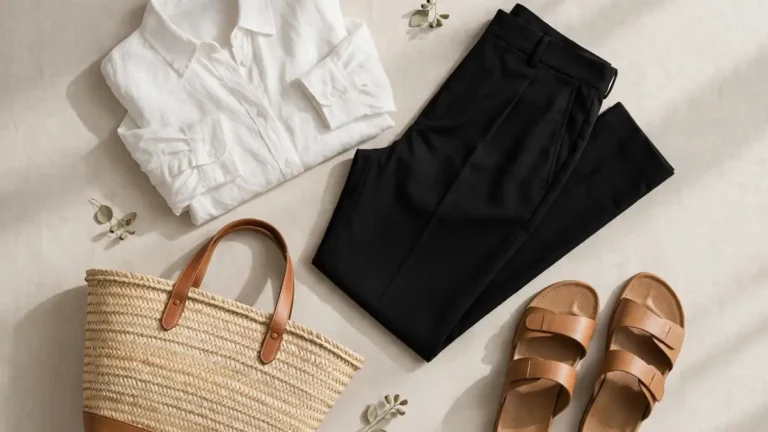
The white shirt is a capsule staple, and a gaping shirt is a capsule failure above a size 14. The fix is in the pattern: bust darts or princess seams, buttons placed to sit flat across a fuller bust, and a back pleat or a touch of stretch. Buy a cotton or cotton-blend poplin that holds its shape, not a flimsy fabric that goes sheer. Tucked into the trousers, open over the camisole, or knotted with jeans, it is three outfits on its own.
5. The A-Line Ponte Midi Skirt
An A-line skirt in ponte knit gives the capsule its second bottom half and its most forgiving silhouette. Ponte holds its shape, smooths without clinging and needs no ironing, and the A-line cut flares gently so it moves over the hips instead of riding up. Pick knee-length or midi in black or navy, with a wide waistband that stays flat when you sit.
6. The Relaxed Tee in Quality Cotton
Not a boxy straight-size tee graded up, but one with a slightly longer body, a neckline that sits flat, and sleeves with room through the upper arm. The fabric is the point: a mid-weight organic cotton jersey that holds its shape through the wash, rather than thin jersey that goes sheer in a month. In white and in black, this is the piece that makes the capsule casual.
7. Wide-Leg Linen Trousers
Australian summers demand linen, and a wide-leg linen trouser is the warm-weather anchor of the capsule. The wide leg is forgiving through the thigh, the high rise sits comfortably, and linen breathes in a way no synthetic can. Choose a mid-weight linen that drapes, in stone or navy. With the tee and sandals it is a weekend outfit; with the shirt and blazer, summer workwear.
8. The Sleeveless Shell Top
A sleeveless shell in crepe or a silky woven fabric is the capsule’s quiet layering piece. Worn alone in summer, under the blazer at work, or under the cardigan in cooler months, it adds polish without bulk. The curve details matter: armholes cut generously enough to sit flat, a neckline that neither gapes nor chokes, and enough length to stay tucked.
9. The Open Knit Cardigan
A long, open-front cardigan in fine merino or a cotton-blend knit is the capsule’s soft layer — warmth without the blazer’s structure, and the easiest way to make jeans and a tee look deliberate. Look for a knit that drapes rather than bulks, a mid-thigh length, and pockets placed where they do not add width at the hip. In stone or charcoal, it carries the capsule through winter and air-conditioned offices alike.
10. Dark Straight-Leg Jeans with Stretch
Jeans are the piece most plus-size shoppers dread, and the one where the right pair changes everything. The checklist is specific: a contoured waistband that closes the back gap, a mid-to-high rise, a straight leg, and 2 to 5 percent elastane so the denim recovers instead of bagging at the knees. Dark indigo or black, with no fading or distressing, so they work with the blazer as well as the tee.
Outfit Formulas: Ten Pieces, Twenty Outfits
A capsule means never thinking about what to wear. These five formulas use only the pieces above.
Work, polished: white button-down tucked into straight-leg trousers, blazer on top; swap in the A-line skirt or wrap dress with the blazer for two more work outfits. Our best workwear brands for women in Australia guide covers the labels that cut office dressing for curves.
Weekend, relaxed: wide-leg linen trousers with the tee, cardigan over the shoulders if the evening cools. Swap in jeans and tee with the shell under the cardigan for a cooler day; both need only sandals or white sneakers.
Dinner or event: the wrap dress on its own, with the blazer over the shoulders if the room is cold. The A-line skirt with shell top and blazer is the same polish in separates, for anyone who prefers not to wear dresses.
Travel: dark jeans, tee, cardigan and the shell layered underneath — everything soft, nothing that creases badly, and the blazer folded over the arm for arrival.
Smart casual: the A-line skirt with the white shirt, sleeves rolled, blazer optional. It suits lunches, school events and anything where jeans feel too casual and a dress feels too much.
Fabric and Fit Notes for Curves
Fabric does more work at plus sizes, because it has to manage drape over curves rather than hang from a straight frame. Structure where you want shape, drape where you want ease: ponte and stretch suiting for trousers and blazers, jersey and crepe for dresses, linen for summer, merino for knits. A fabric with 2 to 5 percent elastane is more forgiving than a rigid weave, and it recovers its shape through the day instead of bagging.
Avoid cheap stiff synthetics: they do not drape, they do not breathe, and they make a garment look cheaper than it is. Check the composition label — a mostly-polyester “linen-look” blend will not breathe like linen, and a mostly-acrylic knit will not last like merino or cotton.
Alterations are part of the capsule, not a failure of it. Taking in a waist or hemming trousers transforms a garment, so budget for one alteration per piece, and buy for your largest measurement — a garment taken in always looks better than one stretched to its limit. Measure your bust, waist and hips before ordering online and compare against each brand’s size chart, because a size 18 at one label is not a size 18 at another.
Where to Buy Each Piece
The labels that design from a curve block are the ones to shop first, and our plus-size fashion brands guide covers them in full — dedicated curve specialists, minimal tailoring labels and budget options, with fit notes for each. In brief: City Chic is the strongest one-stop shop for curve-cut dresses and suiting, since curves are its entire business; Commonry is the minimalist pick for tailored trousers and blazers; and Taking Shape is the best source for natural-fibre tops and linen.
Department stores are useful for discovery: Myer and David Jones both carry curve edits where you can try several labels side by side in one afternoon, and THE ICONIC’s easy returns make online fit-guessing low-risk. Use them to learn which labels fit you, then buy direct for the best range. For the general principles — piece counts, palettes and seasonal swaps — our Australian capsule wardrobe guide is the companion read.
Building Your Plus Size Capsule Wardrobe
Start with what you already own. Pull out everything you wore in the last month and check it against the ten-piece list: does it pair with at least three other pieces, does it fit without adjusting, and would you buy it again tomorrow? Keep what passes. The gaps are your shopping list — buy trousers and blazer first, since they anchor the most outfits.
Colour is the quiet decision that makes the capsule work. A neutral base of black, white, navy and stone means everything matches, and one accent you love — olive, soft blue, warm red — in a single piece keeps it from feeling like a uniform. Cost-per-wear is the honest judge: well-cut trousers worn a hundred times cost less per wear than a cheap pair that bags out after ten washes. Ten pieces that fit, in colours that mix — that is the system, and it works because the fit was designed for you, not graded up to you.
FAQs
How many pieces are in a plus size capsule wardrobe?
Ten pieces is the sweet spot: a wrap dress, straight-leg trousers, a tailored blazer, a white button-down, an A-line ponte skirt, a relaxed tee, wide-leg linen trousers, a sleeveless shell, an open knit cardigan and dark straight-leg jeans. Each piece pairs with at least three others, so ten pieces make twenty-plus outfits.
What is a curve block in plus size clothing?
A curve block is a base pattern built for plus bodies from the start, rather than a straight-size pattern graded bigger. It builds in a higher waist-to-hip ratio, darts placed for a fuller bust, armholes cut for fuller upper arms and a rise shaped for a rounded hip. Labels that design from a curve block fit curves far better than labels that scale a size-10 pattern up.
Which fabrics work best in a plus size capsule wardrobe?
Ponte knit and stretch suiting for trousers, skirts and blazers, because they hold their shape and smooth without clinging. Jersey and crepe for dresses, mid-weight linen for summer trousers, and merino or cotton-blend knits for layers. Look for 2 to 5 percent elastane, and check the composition label — a mostly-polyester “linen-look” fabric will not breathe like real linen.
Where can I buy a plus size capsule wardrobe in Australia?
Start with dedicated curve labels that design from a curve block: City Chic for dresses and suiting, Commonry for minimalist tailored pieces, and Taking Shape for natural-fibre tops and linen. Myer, David Jones and THE ICONIC all carry curve edits for trying labels side by side, and our plus-size fashion brands guide covers the full list with fit notes.
How do I stop plus size trousers gaping at the waist?
Buy trousers with a contoured waistband — one curved to follow the waist-to-hip difference instead of cut straight across — and buy for your hip measurement, then have the waist taken in. A tailor can take in a waistband for a modest cost — a garment taken in always looks better than one stretched to fit. Ponte and stretch suiting fabrics also help hold the waistband’s shape through the day.