
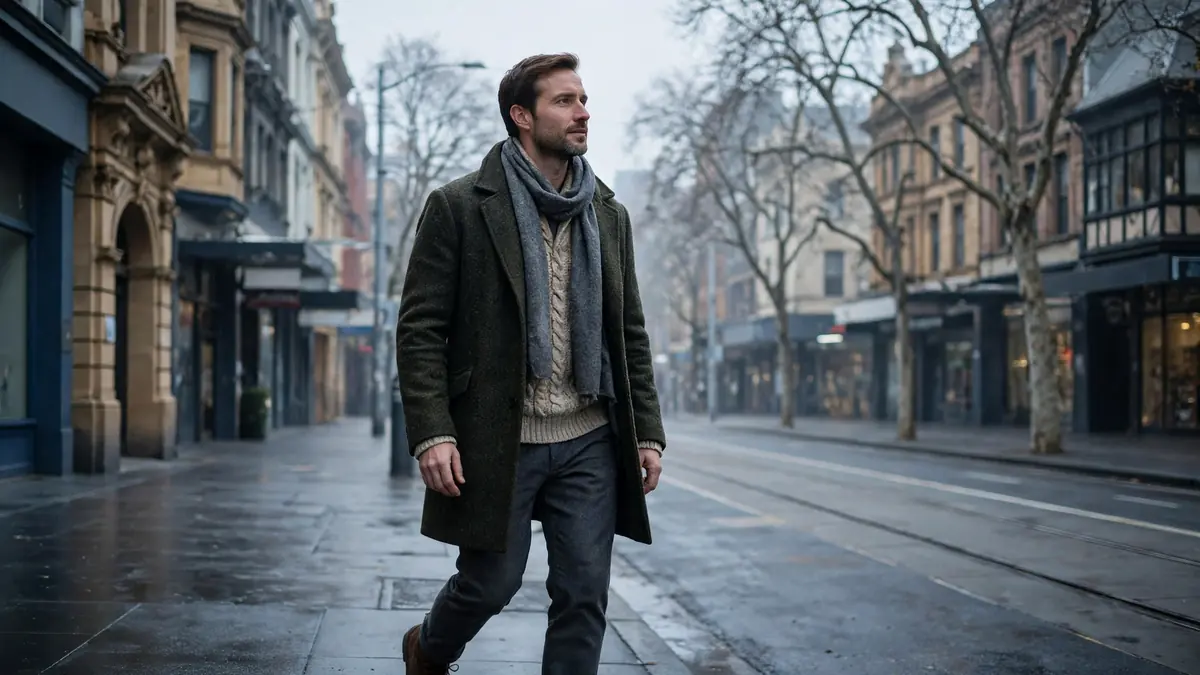
Men’s Winter Style Guide for Australia 2026
Men’s winter fashion Australia 2026 is a different game to winter dressing anywhere else. June to August here doesn’t mean snow and sub-zero commutes — it means crisp Melbourne mornings, mild Sydney afternoons, and Brisbane days where a jacket is optional by lunch. The challenge isn’t surviving the cold; it’s dressing well across a season where the temperature can swing 15 degrees in a day and a “freezing” morning in one city is a pleasant afternoon in another.
This guide is built for that reality: the coats worth owning, the knitwear that does the heavy lifting, boots that handle wet pavements, and layering formulas that work from a Hobart winter to a Gold Coast one. No imported advice about parkas you’ll never need — just what actually suits an Australian winter in 2026.
How Australian Winter Actually Works
Start with geography, because one winter wardrobe does not fit all of Australia.
- Melbourne, Hobart, Canberra: the real deal by Australian standards. Frosty mornings, daytime highs often in the low teens, and wind that cuts through thin layers. This is long-coat and proper-knitwear territory.
- Sydney, Adelaide, Perth: mild and changeable. Cool mornings, pleasant afternoons, the occasional genuinely cold snap. Layering pieces earn their keep here — a good jacket over knitwear covers most days.
- Brisbane, Gold Coast, Darwin: winter-lite. Days in the low twenties are normal; evenings need a light layer at most. A quilted vest, a bomber or a heavy overshirt is usually plenty.
The common thread is variability. An Australian winter day often starts cold, warms up by midday and cools sharply after dark. That makes layering — not one heroic heavy coat — the core skill of men’s winter fashion in Australia. Build outfits in removable layers and you’ll be comfortable at 8am and 3pm alike.
Men’s Winter Fashion in Australia: The 2026 Outerwear Picture
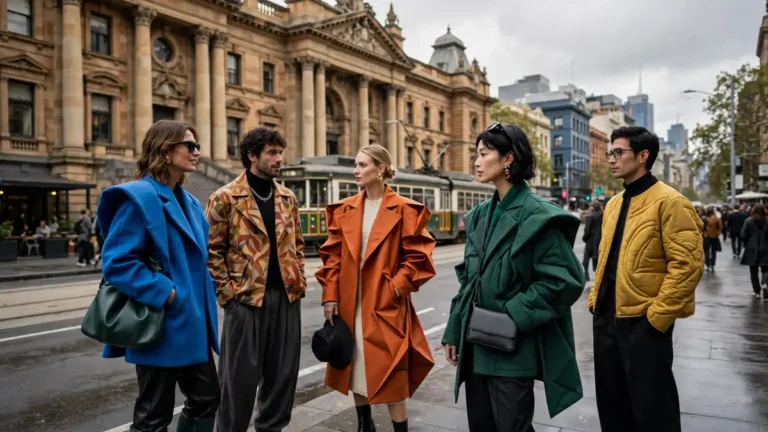
Winter 2026 in Australia is leaning towards restraint: longer, looser silhouettes, tactile fabrics and neutrals that have expanded well beyond black and camel into grey, olive and chocolate. Puffers, bombers and blazers continue to dominate what men actually wear, while the trench and the longline coat remain the most polished options.
If you buy one piece of outerwear this winter, make it a midweight neutral coat that works across workdays, weekends and travel — a trench or a longline wool coat in camel, grey or navy. It’s the single most versatile item in winter menswear, and it instantly sharpens everything underneath it, from a suit to jeans and a knit.
The puffer deserves a note of caution. A massive expedition-grade puffer looks out of place across most of Australia; a cropped or lightweight puffer makes far more sense in Brisbane or Sydney, while Melbourne and Hobart can carry longer, more substantial quilted coats. Match the jacket to your city’s winter, not to a northern-hemisphere catalogue.
Coats Worth Owning
You don’t need five coats. Two or three good ones, chosen well, cover an Australian winter completely.
The trench coat
The trench is the hardest-working coat in menswear. Water-resistant, layerable over tailoring or casual clothes, and sharp in every neutral from stone to navy to black. Look for a mid-thigh or knee length, a proper storm flap and a belt you can cinch on windy days. It handles Sydney rain, Melbourne chill and everything in between.
The wool overcoat
For colder cities and dressier moments, a longline wool or wool-blend overcoat is unmatched. Wear it over a suit for work or over a hoodie and jeans on weekends — the contrast is the point. Dark charcoal, camel or navy; single-breasted for versatility. Australian brands have a natural advantage here given the country’s wool heritage — Peter Jackson’s Winter 26 collection, for example, is built on premium Australian merino wool with softer, more natural tailoring designed for everyday wear rather than just formal occasions. You can browse their current winter range here.
The puffer or quilted jacket
For weekends, sport and the school run, nothing beats a puffer for warmth per dollar. Choose a matte finish (shiny puffers cheapen every outfit), a clean silhouette without excessive branding, and a length that suits your climate — cropped for warmer cities, longer for Melbourne and Hobart.
The bomber and the field jacket
These are the in-betweeners: warmer than an overshirt, less formal than a coat. A suede or leather bomber adds texture to simple outfits; a field jacket with its utility pockets handles wet weekends and looks better the more it’s worn. Both sit comfortably in the smart-casual zone that dominates Australian winter dressing.
Knitwear: The Engine Room of Men’s Winter Fashion in Australia
If outerwear is what people see, knitwear is what keeps you warm. A good knit collection means you can wear lighter jackets through most of winter and still be comfortable.
The merino crewneck
The single most useful knit a man can own. Merino wool regulates temperature, resists odour (you can genuinely wear it multiple times between washes) and layers under everything from a blazer to a puffer. Australia’s connection to merino runs deep — it’s our fibre — so buying Australian merino is both good sense and good shopping. Own it in navy, charcoal and one lighter tone like oatmeal or camel.
The rollneck
A fine-gauge rollneck under a blazer or overcoat is one of the sharpest winter moves available: no shirt, no tie, all polish. It also replaces a scarf on all but the coldest days. Black and navy are the safe bets; burgundy or forest green add character.
The quarter-zip and the cardigan
The quarter-zip is the office-friendly middle ground — smarter than a hoodie, easier than a collared shirt. The cardigan, meanwhile, has quietly become one of the most versatile layers in menswear: wear it buttoned as a blazer alternative, open over a tee, or under a coat for extra warmth. A shawl-collar cardigan in chunky wool is a winter weekend staple.
Knitwear care is simple but non-negotiable: fold, never hang (hangers stretch the shoulders); wash cold and infrequently; dry flat. A $150 merino knit treated well will outlast three $50 ones treated badly.
Trousers, Denim and Boots
Winter is when the bottom half of the outfit finally gets interesting. Shorts are retired; trousers take over.
Denim
Dark, unwashed or rinsed denim is the winter default — it pairs with every knit and every coat, and it looks better as it ages. A straight or slim-straight leg in indigo or black covers nearly everything. Save the light washes and rips for summer.
Chinos and wool trousers
Chinos in olive, charcoal and navy bridge the gap between jeans and tailoring. For smarter days, a pair of wool-blend trousers with a proper crease transforms a knit-and-coat outfit into something office-ready. Flat-front, tapered slightly, hemmed to sit on the shoe with minimal break.
Boots
Winter footwear in Australia means boots — wet pavements, cold mornings and long trousers all point the same way.
- Chelsea boots: the smartest option. A black or dark brown Chelsea boot works with suits, wool trousers and dark denim alike. Elastic sides mean easy on and off; a leather sole looks sharper, a rubber sole handles rain.
- Lace-up leather boots: more rugged, more versatile. A derby or brogue boot in brown leather pairs with everything from chinos to denim and ages beautifully.
- Sneakers: still fine for casual days, but choose leather or suede over canvas in winter, and darker colours that handle wet streets.
Whatever you wear, weatherproof it. A spray protector on suede and regular conditioning on leather will double the life of winter shoes.
Layering Formulas for Men’s Winter Fashion in Australia
Layering is a skill, not a pile of clothes. The formula is simple: base + mid + outer, each layer visible and each one removable.
- The office: collared shirt + merino crewneck + unstructured blazer or overcoat. The knit replaces the tie; the coat handles the commute. Lose the coat at your desk, lose the knit if the heating’s blasting.
- The weekend: henley or tee + quarter-zip or cardigan + puffer or field jacket, with dark denim and boots. Warm, comfortable, presentable at the pub.
- The night out: rollneck + tailored trousers + wool overcoat + Chelsea boots. Minimal pieces, maximum effect — the rollneck-and-coat combination is close to foolproof.
- The cold snap: thermal base layer + shirt + chunky knit + long coat + scarf. Melbourne and Canberra get mornings near freezing; a proper thermal underneath changes everything without adding visible bulk.
Two rules keep layers looking intentional rather than lumpy: each layer should be slightly longer than the one beneath it at the hem (shirt peeking below knit, knit below jacket reads as deliberate), and textures should vary — smooth shirt, chunky knit, matte coat. Same-fabric layering looks flat; mixed textures look rich.
Colour and Texture in Winter
Winter 2026’s palette is built on expanded neutrals: black, charcoal, navy and camel, joined by grey, olive and chocolate. This is good news — these colours all work together, which makes getting dressed in the dark at 7am nearly foolproof.
The interest comes from texture rather than colour. A brushed wool coat over smooth denim. A cable-knit sweater with flat chinos. Suede boots with a matte puffer. Corduroy trousers with a fine merino crew. When the colours are quiet, the fabrics do the talking — and this is where Australian winter dressing can look genuinely luxurious without a single loud piece.
One accent colour per outfit is the limit. A burgundy scarf, an olive field jacket, a pair of tan boots — pick one, keep everything else neutral, and the accent reads as confidence rather than noise.
What to Spend On vs Where to Save
Winter wardrobes reward strategic spending:
- Spend on: the coat, the boots, one great merino knit. These are the pieces people see and the ones that last a decade if chosen well.
- Save on: thermals, scarves, beanies, everyday tees. Uniqlo’s Heattech-style thermals and basic merino-blend layers are excellent value in Australia.
- Never skimp on: fit. A $300 coat that fits is worth more than a $1,000 one that doesn’t. Budget for tailoring — hemming trousers and taking in a coat’s waist are cheap alterations that transform how clothes look.
Accessories: Scarves, Beanies and Gloves
Winter accessories are functional first, but they’re also the easiest way to add personality to a neutral outfit. A wool scarf in a rich colour — burgundy, forest green, camel — lifts a grey coat instantly; learn one proper knot (the Parisian fold: double the scarf, loop the ends through) and you’re set for the season. A simple ribbed beanie in black, navy or grey handles frosty mornings and bad hair days alike — just keep it off your ears’ radar by choosing fine knit over chunky for smarter outfits. Gloves matter more than most Australian men admit: leather gloves for the city, knit for weekends, and touchscreen-compatible pairs if you live on your phone. In Melbourne and Canberra these aren’t luxuries; on a windy July morning they’re the difference between comfortable and miserable.
More cold-weather reading: the women’s equivalent, our Australian winter fashion essentials guide, shares the same layering logic, and our grey suit guide covers the tailored end of a winter wardrobe.
FAQs
What do men wear in winter in Australia?
Layering is the foundation: a base layer or shirt, a merino knit, and a midweight coat such as a trench, wool overcoat or puffer. Dark denim or wool trousers with boots complete the outfit. Australia’s mild climate means midweight pieces worn in layers beat one heavy coat.
Do men need a heavy winter coat in Australia?
Most Australian men don’t. A midweight wool overcoat or trench over knitwear handles the coldest days in Melbourne, Hobart and Canberra. Only those in genuinely cold regions or working outdoors need heavy-duty insulation — for everyone else, layering is warmer and more versatile.
What is the best winter jacket for men in Sydney or Brisbane?
A lightweight puffer, a bomber jacket or a quilted vest suits Sydney’s mild winter, while Brisbane usually needs only a bomber, a heavy overshirt or a light quilted layer. Save the long wool coat for trips south.
How should men layer clothes in winter without looking bulky?
Use thin, warm layers: a thermal or fitted base, a fine merino knit, then your outer layer. Keep each layer slightly longer than the one beneath at the hem, vary textures between layers, and make sure shoulders fit properly — bulk usually comes from poor shoulder fit, not from the number of layers.
Are Chelsea boots good for Australian winter?
Yes — they’re one of the most versatile winter shoes for Australian men. A black or dark brown pair works with suits, wool trousers and dark denim. Choose a rubber sole if you’ll face wet pavements regularly, and weatherproof the leather.