
Building an Australian Capsule Wardrobe in 2026
If your wardrobe is full but you still stand there every morning with nothing to wear, you’re not alone. The capsule wardrobe Australia has been waiting for — one built for our climate, our light and our laid-back dress codes — might be the smartest style move you make this year.
This guide covers how to build a capsule wardrobe for Australian life in 2026: how many pieces you need, which ones earn their place, colours that suit our harsh light, where to shop at every budget, and how to swap between our long summers and shorter winters.
What a capsule wardrobe actually means
The term “capsule wardrobe” was coined by Susie Faux, owner of the London boutique “Wardrobe”, back in the 1970s. Her definition was refreshingly practical: a small collection of essential items that don’t date, like skirts, trousers and coats, that you could then build on with seasonal pieces. American designer Donna Karan popularised the idea in 1985 with her famous “Seven Easy Pieces” collection — seven interchangeable workwear pieces that could be mixed into a whole working wardrobe. You can read more about the history of the concept on Wikipedia’s capsule wardrobe page.
Somewhere along the way, capsules became associated with owning almost nothing and wearing head-to-toe beige. That’s not what we’re doing here. A proper capsule is about intention: every piece earns its hanger by working with most of the other pieces in your wardrobe.
For Australians, the appeal is particular: we dress more casually than Europeans or Americans, our weather swings from tropical to temperate, and few of us have storage for a wardrobe that only works three months a year. A good capsule solves all of that.
Why a capsule wardrobe suits the Australian way of life
Think about the average Australian week: an air-conditioned office, a school run in 30-degree heat, then a weekend spanning beach mornings, long lunches and dinners out. Few wardrobes flex across that range, which is why most of us own too much and wear too little of it.
Our climate makes the case even stronger. In Brisbane and Darwin, you need a wardrobe that breathes for most of the year, with just a light layer for the occasional cool snap. In Melbourne, you’re dressing for four seasons in a day and need pieces that layer without bulk. Sydney sitters want polish that survives humidity. Perth wants sun-smart fabrics that don’t wilt by 3pm. A capsule wardrobe built around breathable natural fibres, smart layering pieces and a coherent colour palette handles all of this better than a rail of impulse buys.
There’s a money argument too. Most of us wear a small fraction of our wardrobe most of the time — a capsule flips that ratio. When every piece coordinates, your cost-per-wear plummets. That $149 Country Road blazer (marked down from its $399 RRP in a recent sale) is a bargain when worn three times a week for two years.
How many pieces should your capsule hold?
The right number depends on your lifestyle, laundry habits and climate, but a useful starting framework for an Australian adult is 30 to 37 pieces, not counting underwear, sleepwear, gym gear or formal wear.
Here’s a breakdown that works well as a starting point:
- Tops: 8–10 (a mix of tees, shirts and blouses)
- Bottoms: 5–6 (jeans, tailored trousers, a skirt, shorts)
- Layers: 4–5 (blazer, knit, cardigan, jacket, coat)
- Dresses: 3–4 (day dress, dressier midi, versatile wrap)
- Shoes: 4–5 pairs (sneakers, sandals, flats or loafers, boots, one dressy pair)
- Bags and extras: 2–3 (everyday bag, evening option, scarf or belt)
That lands you around 33 pieces — enough variety that nobody will notice you’re working from a tight rotation, but few enough that everything gets worn. If you do shift work, exercise daily or hate doing laundry more than twice a week, nudge the tops and bottoms up a little. If you work from home most days, you can trim the tailored pieces and lean into smart casual.
Before anything enters your capsule, apply the 30-wear test: will you wear it at least 30 times? A $60 tee worn 60 times costs a dollar a wear; a $300 dress worn twice costs $150 a wear.
The capsule wardrobe Australia checklist: piece by piece
Below is a piece-by-piece checklist tuned for Australian conditions. Treat it as a menu, not a mandate — the goal is a collection where almost any top works with almost any bottom.
Tops and shirting
Tops are the workhorses of any capsule, so this is where fit matters most. Start with three quality tees in white, black and a neutral like stone or navy — look for a mid-weight cotton or cotton-modal that holds its shape through the wash. Add two button-up shirts: one crisp white (non-negotiable, it goes with everything) and one in chambray or a soft stripe for texture. A Breton stripe top earns its place in almost every Australian capsule — it’s the rare pattern that behaves like a neutral. Round out the category with two smarter tops in fabrics that don’t need ironing — silk-touch synthetics, crinkle viscose or stretch crepe. If a top needs 10 minutes with the iron, you won’t reach for it.
Bottoms
One pair of dark-wash jeans with no distressing, one pair of black tailored trousers with stretch (office to dinner without a change), one pair of relaxed linen-blend trousers for hot days, a midi skirt in a neutral, and tailored shorts for summer weekends. Five bottoms covering everything from client meetings to coastal walks.
Layers and outerwear
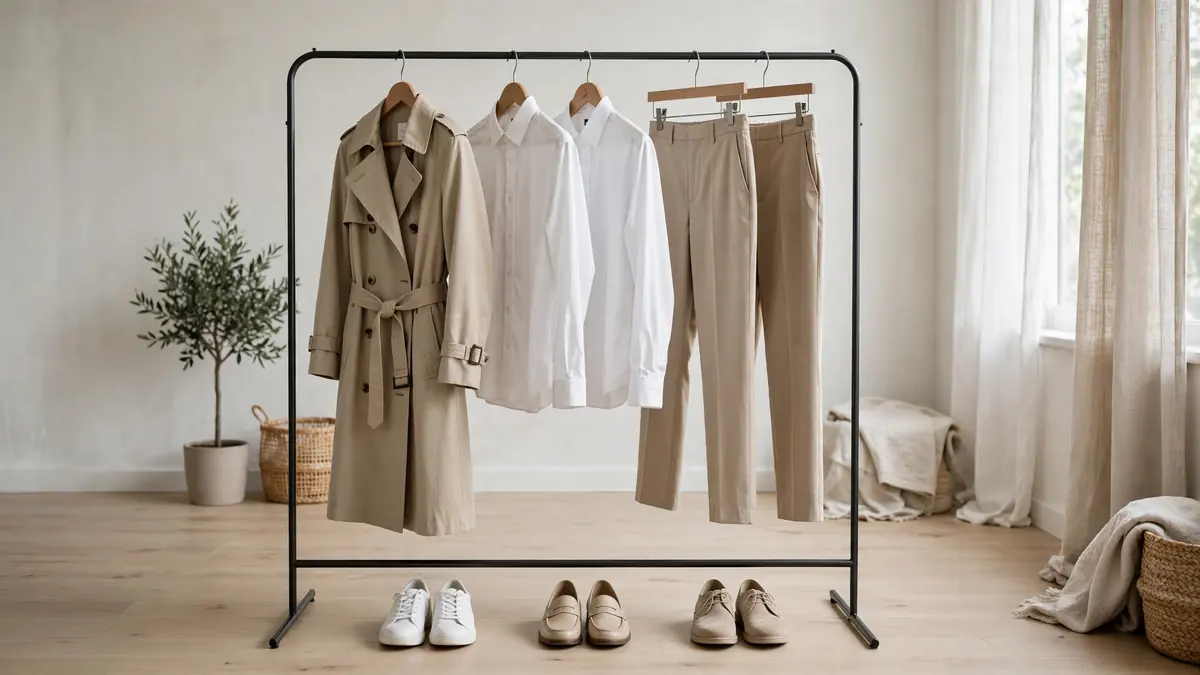
Forget the heavy wool overcoat as your cornerstone — most of us need it three weeks a year. Build around a tailored blazer in black or navy, a lightweight merino knit, and an unstructured jacket like a linen blazer for weekends. Add a trench or water-resistant coat for rainy weeks, and one proper winter coat only if your city earns it.
Dresses and one-pieces
Include a day dress in breathable cotton or linen you can throw on without thinking, a dressier midi in black or a rich neutral for dinners and events, and a third versatile dress — a wrap style or simple slip. If dresses aren’t your thing, swap in jumpsuits or co-ord sets for the same one-and-done ease.
Shoes and accessories
Your five pairs: white leather sneakers, flat sandals in tan or metallic, loafers or ballet flats, ankle boots with a manageable heel, and one dressy pair for occasions. Keep accessories tight: one everyday bag, one evening bag, a classic watch and a winter scarf. Accessories are where capsules blow out — be ruthless.
Choosing a colour palette that works in Australian light
Australian light is unforgiving, and colours that look sophisticated under northern-hemisphere skies can look washed out here. Build on warm neutrals — stone, camel, warm white, soft navy — which flatter skin in strong daylight and hide sunscreen marks and dust far better than stark black or optic white.
A practical formula: pick three base neutrals (say, black, stone and navy), two accent colours you love (olive and rust, or dusty blue and terracotta), and one pattern (stripe or a subtle check). Every new piece you consider has to sit inside that palette. This is the single rule that makes mornings effortless — when everything shares a colour story, mismatches become almost impossible.
Don’t skip black entirely — it’s still the backbone of evening dressing. Just balance it with lighter tones near your face; head-to-toe black in harsh midday sun can look severe. A warm white tee under a black blazer is the classic fix.
Capsule wardrobe Australia: where to shop every budget
You don’t need designer budgets to build a strong capsule, but you do need to be strategic about where you spend. The pieces that get the most wear — blazer, trousers, jeans, everyday bag, white sneakers — deserve the biggest slice of your budget. The pieces that are simple and replaceable — basic tees, tanks, casual shorts — are where you save.
For budget basics, Kmart, Target and Big W are hard to beat for tees, tanks and casual layers; UNIQLO is the sweet spot for knitwear and well-cut basics. For mid-range workhorses — blazers, tailored trousers, shirting — Country Road, Witchery, Saba, Trenery and Decjuba are the Australian staples, with blazers typically $150 on sale to $300–$400 at full price. For investment pieces, Viktoria & Woods, Camilla and Marc or Scanlan Theodore justify $500–$700 blazers if you’ll wear them hundreds of times.
Two rules save more money than any sale. First, shop your own wardrobe first — you probably own half the pieces already. Second, never buy at full price in week one: Australian retailers discount deeply and often, and patience routinely saves 30 to 50 per cent.
Seasonal swaps: taking your capsule from summer to winter
Don’t build two separate wardrobes. A smarter approach is a core capsule with seasonal swaps: two-thirds of your pieces work year-round, and you rotate the remaining third.
Your year-round core includes your jeans, black trousers, white shirt, tees, blazer, day dress and sneakers — the pieces that work in February and July alike with different layering. For summer (roughly October to March in most of the country), swap in linen trousers, tailored shorts, flat sandals, sleeveless tops and your lightest dresses; pack away heavy knits, boots and the winter coat. For winter (June to August, longer in Melbourne, Hobart and Canberra), bring in merino knits, ankle boots, the trench and a scarf, and retire the shorts and strappy sandals.
Autumn and spring are where your capsule earns its keep: a tee under a blazer with jeans works from March to November in Sydney with just a shoe change. Store off-season pieces out of prime wardrobe real estate — and if you haven’t reached for something by season’s end, it probably doesn’t belong.
Mistakes to avoid when building your capsule
Buying everything at once tops the list of capsule killers — a weekend shopping spree always includes pieces you won’t wear. Build gradually. Ignoring your real life is the second trap: if you work from home four days a week, corporate suiting is fantasy dressing. Audit your last month and build for that life.
Choosing style over comfort kills more capsules than anything else — the trousers that dig in when you sit simply won’t get worn. Skimping on fit is the quieter version: a $40 alteration transforms a piece, so budget for tailoring like the clothes themselves.
Finally, don’t confuse a capsule with a uniform. Keep a few pieces purely for joy — the printed dress, the coloured bag. A capsule with no personality isn’t sustainable.
Go deeper on capsule dressing: our earlier capsule wardrobe guide takes a menswear-leaning approach to the same idea, the philosophy behind both is unpacked in Buy Less, Choose Well, and the brands worth building a capsule around are in our best Australian fashion brands for women round-up.
FAQs
How many clothes should be in a capsule wardrobe in Australia?
Most Australian adults do well with 30 to 37 pieces, excluding underwear, sleepwear and activewear: 8–10 tops, 5–6 bottoms, 4–5 layers, 3–4 dresses and 4–5 pairs of shoes. Adjust up for shift work, down if you work from home.
What is the 3-3-3 rule for capsule wardrobes?
The 3-3-3 method means wearing only 3 tops, 3 bottoms and 3 pairs of shoes for three months. It’s a useful experiment to discover your true essentials, but too restrictive as a permanent wardrobe.
How much does it cost to build a capsule wardrobe in Australia?
A solid mid-range capsule of around 33 pieces typically costs $2,000–$4,000 new — less with sales and pieces you own. Spend on high-wear items like your blazer and jeans; save on basics from Kmart, Target or UNIQLO.
Can a capsule wardrobe work for unpredictable Melbourne weather?
Yes — layering pieces are the backbone of the system. Build around a blazer, merino knit, trench and scarf, and you’ll handle a 14-degree morning and a 28-degree afternoon without changing.
How often should I update my capsule wardrobe?
Review each season: retire what you didn’t wear, replace worn-out staples, and add one or two pieces that fill genuine gaps. A good capsule evolves gradually.